Developmental Milestones Parents Should Watch for in Early Childhood
Developmental milestones can feel like a lot to track, especially when every app, chart, and well-meaning relative seems to have a different opinion. But milestones are not a test your child passes or fails. They are practical guideposts that help you notice how your child is growing, connecting, moving, communicating, and learning over time.
For parents, the most helpful approach is not to memorize every milestone. It is to know which early signs matter most, what changes to mention to your pediatrician, and how to observe your child calmly during everyday routines.
Start with the foundations, not the longest checklist
The phrase developmental milestones usually refers to skills most children reach by a certain age, such as smiling, rolling, sitting, babbling, pointing, walking, or using words. The CDC milestone guidance is organized by age and developmental area, and it is designed to help families notice progress and raise concerns early.
That last part matters. Milestones are useful because early support can make a meaningful difference when a child needs extra help. They are not meant to turn normal variation into panic. Some children walk early and talk later. Others say several words before they feel confident climbing. Temperament, birth history, health, sleep, nutrition, and environment can all affect the timeline.
If your baby was born premature, ask your pediatrician whether you should follow corrected age when thinking about milestones, especially during the first two years. Corrected age can give a more accurate picture of development for babies born early.
The developmental milestones parents should watch first
When you are deciding what to pay attention to first, focus on the skills that show how your child is interacting with the world. These are the milestones that often give the earliest clues about overall development.
Social connection and responsiveness
One of the first things to watch is whether your baby responds to people. Early social developmental milestones include calming to a familiar voice, looking at faces, making eye contact, smiling socially, and later seeking your attention through sounds, gestures, or expressions.
A social smile around the early months is more than adorable. It is a sign that your baby is beginning to connect with caregivers. As your child grows, shared attention becomes important too. This includes looking where you point, showing you an object, or checking your face for reassurance.

If your baby rarely responds to voices, does not seem interested in faces, or loses social skills they previously had, it is worth bringing up promptly. These signs do not automatically mean something is wrong, but they are important enough to discuss.
Feeding, growth, and early body control
Feeding is not always listed as a classic milestone, but it is one of the first areas parents should watch because it affects energy, growth, sleep, and daily comfort. In the newborn stage, notice whether your baby can suck, swallow, stay alert enough to feed, and gain weight as expected.
As your baby grows, feeding development becomes connected to posture, oral motor skills, and coordination. Head control helps with safe feeding. Sitting with support helps when solids begin. Later, finger feeding and using a cup reflect growing hand, mouth, and body coordination.
If feeding is consistently stressful, your baby tires quickly, coughs or chokes often, has poor weight gain, or seems unusually floppy or stiff, ask your pediatrician for guidance. For more practical early-care routines, InspireParent’s baby care tips can help you think through daily patterns like feeding, sleep, and comfort.
Hearing, vision, and sensory awareness
Before parents worry about speech delays, it is important to ask a simpler question: can the child hear and see well enough to learn from the world around them?
Babies typically startle at loud sounds, turn toward familiar voices, watch faces, track movement, and later respond to their name. Vision and hearing shape communication, bonding, movement, and learning. A child who is not hearing clearly may not babble or follow directions as expected. A child who is not seeing clearly may seem less interested in faces, toys, or movement.
Even if your newborn passed a hearing screen, concerns can still come up later. Repeated ear infections, limited response to sound, lack of startle, or not turning toward voices are all good reasons to check in.
Movement, strength, and symmetry
Motor milestones are often the easiest to notice because they are visible: lifting the head, rolling, sitting, crawling, pulling to stand, cruising, and walking. But the earliest thing to watch is not whether your baby is the first to roll. It is whether strength and coordination are gradually improving.
Pay attention to symmetry. Does your baby use both sides of the body? Do both hands open and reach? Does your child seem very stiff, very floppy, or strongly prefer one side much earlier than expected? These patterns can be more informative than a single delayed skill.
Tummy time, supervised floor play, and safe opportunities to move give babies a chance to build strength. Avoid comparing your child’s timeline too closely with another baby’s. Instead, look for steady progress from one month to the next.
Communication before first words
Speech does not begin with words. It begins with cries, facial expressions, coos, squeals, babbling, gestures, and shared attention. These early communication milestones are often the ones parents should watch carefully because they show how a child is learning to interact.
Before a first birthday, many babies experiment waith sounds, respond to their name, use gestures like reaching or waving, and look to caregivers for interaction. Around toddlerhood, words usually build gradually from a few meaningful words to word combinations.
A child who is not babbling, not using gestures, not responding to their name, or not trying to communicate in any way should be discussed with a pediatrician. Communication includes more than talking, so describe what your child does use, such as pointing, pulling your hand, making sounds, or making eye contact.
Play, curiosity, and problem solving
Play is how young children learn. Early play may look simple, like staring at a face, mouthing a toy, shaking a rattle, dropping a spoon repeatedly, or searching for a hidden object. These moments show curiosity, memory, cause and effect, and problem solving.
As toddlers grow, pretend play becomes an important sign of cognitive and social development. Feeding a doll, pretending a block is a phone, copying household routines, or making animal sounds all show that your child is connecting ideas.
If a child seems unusually disengaged, does not explore toys or people, or loses interest in skills they once enjoyed, mention it. Development is not only about movement and speech. It is also about curiosity.
A simple age-by-age milestone map
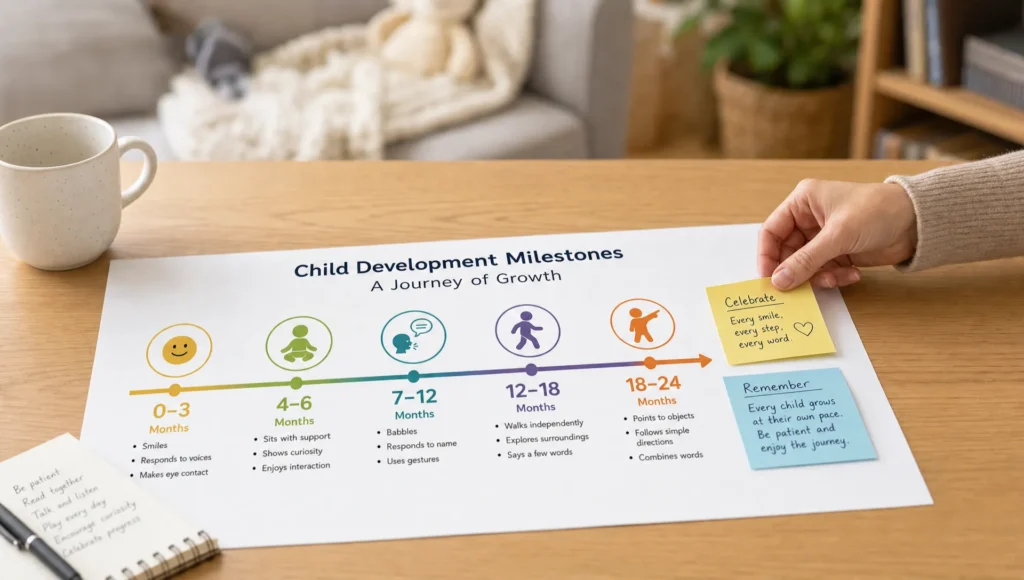
The table below is not a diagnostic tool. It is a parent-friendly way to think about the first Developmental milestones areas to watch at different stages. If your child is missing a skill, look at the whole pattern and ask your pediatrician what it means for your child.
| Age range | Watch first | Examples of progress to notice | When to ask for guidance |
| 0-2 months | Feeding, alertness, response to people | Calms to caregiver, looks at faces, startles to sound, begins lifting head briefly | Trouble feeding, poor alertness, no response to loud sound, very stiff or floppy body |
| 3-4 months | Social smile, head control, early sounds | Smiles at people, coos, follows movement, brings hands to mouth, holds head steadier | No social smile, limited eye contact, poor head control, little response to sound |
| 5-6 months | Reaching, rolling, interaction | Reaches for toys, rolls or attempts to roll, laughs, makes sounds, recognizes familiar people | No interest in interaction, persistent stiffness or floppiness, not using both sides similarly |
| 7-9 months | Sitting, babbling, response to name | Sits with less support, babbles, responds to name, transfers toys, shows curiosity | No babbling, does not respond to name, cannot sit with help, limited interest in people or toys |
| 10-12 months | Gestures, mobility, simple understanding | Waves, points or reaches, pulls to stand, plays peekaboo, understands simple words | No gestures, no back-and-forth sounds, no interest in moving, loss of skills |
| 13-18 months | Walking, words, imitation | Walks or gets close, says a few words, imitates actions, follows simple directions | Not walking by around 18 months, no meaningful words, no pointing, loss of language or social skills |
| 18-24 months | Word combinations, pretend play, independence | Uses more words, begins two-word phrases, runs, copies routines, plays pretend | No word growth, no pretend play, does not follow simple directions, regression at any age |

How to observe milestones without turning every day into a test
The best Developmental milestones observations usually happen during normal life. You do not need flashcards or a complicated tracking system. You need a few minutes of undistracted attention and a realistic sense of what your child usually does.
Try watching during feeding, diaper changes, bath time, floor play, stroller walks, and bedtime routines. Notice how your child responds to your voice, face, touch, and playful sounds. Watch how they move when they are rested compared with when they are hungry or tired.
A simple note on your phone can be enough. Write down the date of a new skill, such as “rolled from belly to back,” “waved at Grandma,” or “said ‘up’ while reaching.” If you are concerned, short videos can help your pediatrician understand what you are seeing at home.
It also helps to compare your child to their own previous abilities rather than to another child. The most important question is often: is my child gaining skills over time? A temporary plateau can happen during illness, teething, poor sleep, or a major routine change. Loss of skills, however, should always be discussed.
For broader age-based guidance, you can explore InspireParent’s child development resources as your child moves from babyhood into toddlerhood and beyond.
When a missed milestone matters
A single missed milestone does not always mean a developmental delay. Pediatricians look at patterns, context, health history, family history, and whether skills are emerging in other ways. For example, a toddler who says fewer words but points, understands directions, imitates, and communicates clearly with gestures may be evaluated differently from a toddler who rarely engages or communicates.
Still, parents should trust their instincts. You do not need to wait until a delay becomes obvious to ask questions. The American Academy of Pediatrics encourages developmental surveillance throughout childhood, meaning doctors and parents should keep watching development over time, not only at one appointment.
Bring up concerns sooner if you notice any of the following patterns:
- Loss of skills your child previously had
- No response to sound, voice, or name when expected
- Persistent feeding trouble or poor weight gain
- Very stiff or very floppy muscle tone
- Strong preference for one side of the body early on
- Little interest in faces, people, or interaction
- No gestures, babbling, or attempts to communicate by the later baby months
- No progress in words, play, or understanding during toddlerhood
You are not overreacting by asking. A pediatrician may reassure you, monitor progress, recommend a hearing or vision check, suggest developmental screening, or refer you for early intervention services. In the United States, families can also learn more about next steps through the CDC’s Act Early guidance for concerns.
What to do if you are worried
If something feels off, start with clear examples. Instead of saying, “I think my child is delayed,” you might say, “She used to babble often, but I have not heard those sounds in several weeks,” or “He does not turn when we call his name, even when the room is quiet.” Specific observations make it easier for your child’s doctor to decide what to check next.
Schedule a visit rather than waiting for the next routine appointment if the concern feels significant, especially if there is regression, feeding difficulty, weakness, or lack of response to sound. If your pediatrician recommends monitoring, ask what you should watch for, when to follow up, and whether screening or referral would be appropriate.
At home, keep supporting development through responsive care. Talk to your baby during routines. Read simple books. Offer supervised floor time. Sing songs with gestures. Let toddlers help with small daily tasks. These everyday interactions build connection, language, movement, and confidence.
If you want more support building predictable family rhythms around meals, sleep, play, and behavior, InspireParent’s parenting advice hub offers practical guidance for busy families.

Keep watching with confidence
Developmental milestones are most helpful when they reduce confusion, not when they create pressure. Watch your child with curiosity. Celebrate small gains. Ask questions early. And remember that your relationship with your child, the talking, feeding, comforting, playing, and daily care, is one of the most powerful supports for healthy development.
For more simple, parent-friendly guidance as your child grows, visit InspireParent and explore resources built to help families track milestones, encourage healthy growth, and build daily routines with confidence.
Frequently Asked Questions
What are the most important developmental milestones to watch first?
Start with social responsiveness, feeding and growth, hearing and vision, movement symmetry, early communication, and curiosity during play. These areas give parents a broad view of how a child is connecting, learning, and using their body.
Should I worry if my child misses one milestone?
Not always. Children develop at different rates, and one missed milestone may not mean a delay. Look for patterns, steady progress, and whether skills are emerging in other ways. If you are unsure, ask your pediatrician.
What is the biggest warning sign in child development?
Loss of skills is one of the most important signs to discuss right away. If your child stops doing something they previously did, such as babbling, making eye contact, using words, walking, or playing socially, contact your pediatrician.
How often should I check developmental milestones?
A quick monthly check is usually enough for parents, along with regular well-child visits. You can also note new skills when they happen naturally rather than formally testing your child every day.
Do premature babies follow the same milestone timeline?
Many premature babies are assessed using corrected age for a period of time. Ask your pediatrician how to track milestones based on your baby’s gestational age, health history, and growth.