This is one of the most common questions new parents ask. The short answer: when can infant see color is not a single moment. It’s a slow, exciting process that unfolds over the first several months. This guide walks you through it, explains what’s going on inside your baby’s eyes, and shows you how to support it at home.
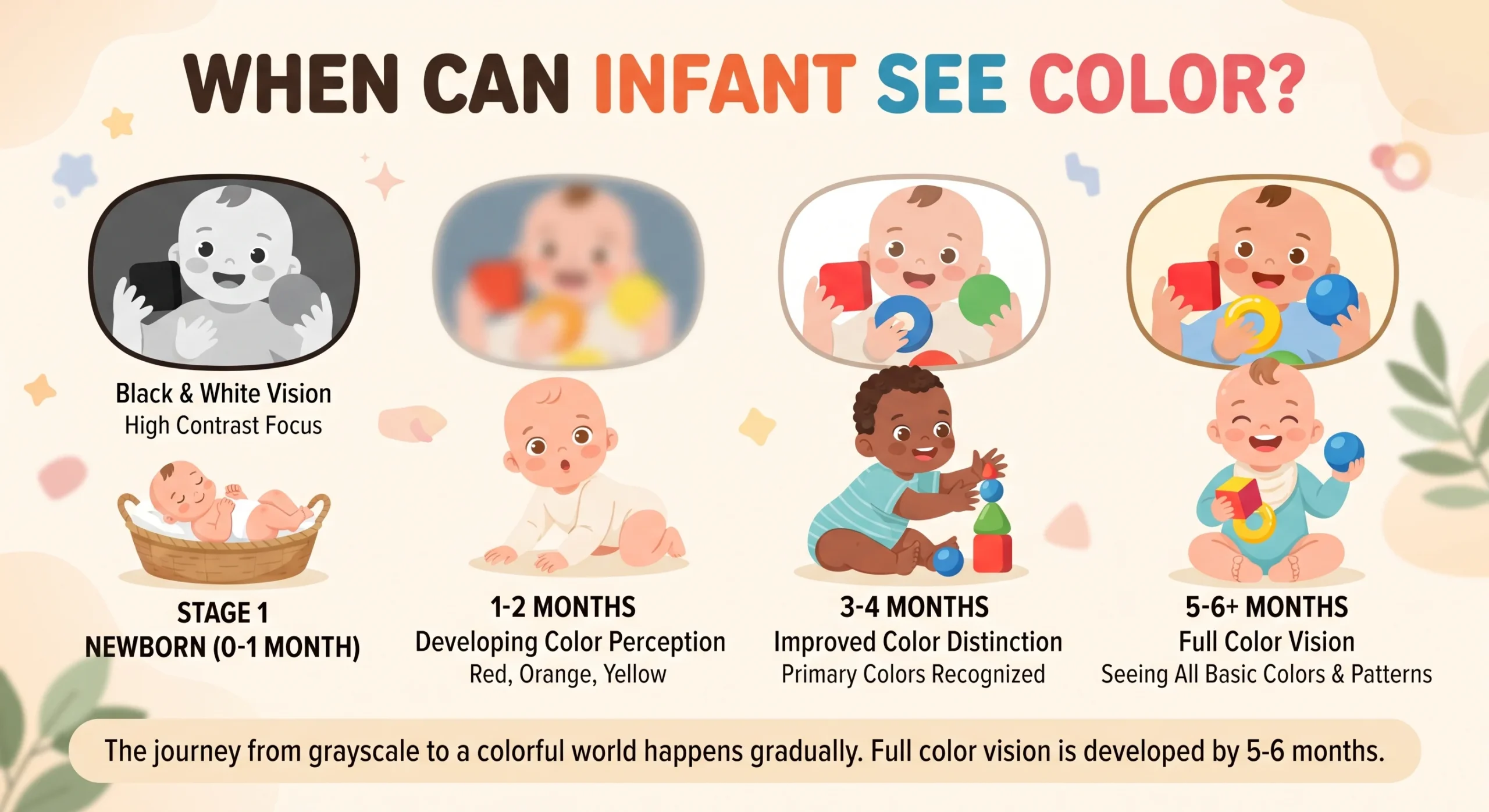
Quick answer: Newborns can pick up some color, especially bold red, but it looks faded to them. Most babies see the full range of colors by about 5 months, and their color vision keeps sharpening through the first year.
Newborn Color Vision: What Your Baby Sees in Week One
For years, people said babies see only black and white. That’s a myth. As one parenting guide on baby color vision explains, experts now think newborns can see some color, just not much.
Here’s the more accurate picture. At birth, your baby’s eyes work, but the brain and eye muscles are still learning to team up. Pathways.org notes that vision is one of the slowest senses to develop. In the first weeks, your baby is mostly drawn to:
Bold shapes with strong edges
High-contrast patterns, like black next to white
Faces, especially yours
Newborns also see best at close range, around 8 to 12 inches from their face. That’s about the distance from your chest to your face while feeding. All About Vision points out that this isn’t an accident. Nature built it so your baby can gaze up at you.
A Quick Story
Imagine a dad named Marcus. In his daughter’s first week, he hung a bright rainbow mobile over her crib. She ignored it. He felt a little sad, until a nurse told him, “She’s not ignoring it. She just can’t see that far yet.” The next day he moved a black-and-white card close to her face, and she stared at it for nearly a minute. Marcus grinned the whole afternoon.
Stories like this are common. The baby isn’t broken, and the toy isn’t wrong. The distance and contrast just weren’t right yet.
Baby Color Vision Timeline: Month-by-Month Milestones
Every baby moves at their own pace. Still, most follow a similar path. Think of the timeline below as a rough map, not a strict schedule.
Birth to 1 Month: Faint Color, Strong Contrast
Color perception is very limited and muted.
Some sources say babies may start picking up red within the first few weeks, since it’s a bold, easy-to-notice color.
Black-and-white and high-contrast patterns grab attention fastest.
Your baby starts to follow a moving object with their eyes.
They may recognize your face across the room and smile.
Colors start looking richer and more distinct.
4 to 5 Months: Full-Color Vision Arrives
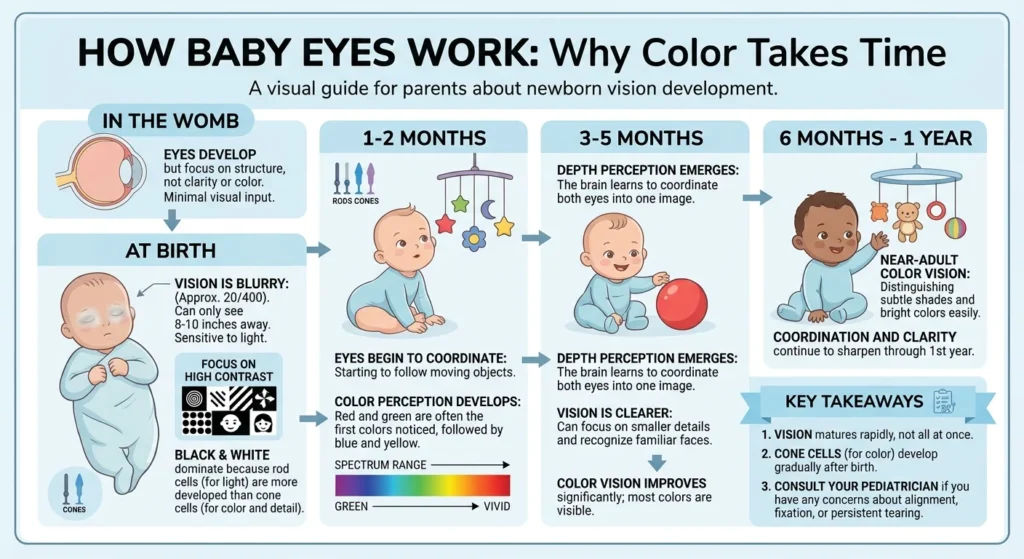
By around 5 months, many babies see colors much like adults do, according to All About Vision.
Bright, bold colors still stand out most. Soft pastels can look a bit gray to young eyes.
Depth perception begins to improve, so the world looks more three-dimensional.
6 to 12 Months: Sharper and Smarter
Color vision keeps being refined.
Your baby can now reach, grasp, and crawl toward what they see. Their eyes and hands begin working as a team.
By their first birthday, they can recognize a wide range of colors and shades.
AboutKidsHealth adds that by about eight months, many babies have near-normal vision, though it keeps improving into early childhood.
How Baby Eyes Work: Why Color Takes Time
You might wonder why seeing color takes months. The answer is in the back of the eye.
The retina has special cells called cones. Cones detect color. Newborns have cones, but they’re still immature, and the brain is still learning to read their signals. Another group of cells, called rods, handle seeing in low light and detecting shapes.
Picture a brand-new TV that’s plugged in but not tuned yet. The picture is there, just fuzzy and washed out. Over the first few months, the “tuning” happens. The cones mature, the nerve pathways strengthen, and the brain gets better at interpreting what it sees.
This is also why red tends to show up first. Different cones respond to different colors, and they don’t all mature at the exact same speed.
Which Colors Can Babies See First?
Parents often ask which colors work best. Here’s what most sources agree on:
Red is often the first color babies notice, usually in the first few weeks to months.
Bold primary colors (red, blue, yellow, green) become easier to tell apart around 3 to 4 months.
Soft or muted shades take longer. Pastels may look grayish until later in the first year.
That doesn’t mean you should buy only red toys. It means variety and contrast matter more than any one color.
Infant Color Perception Research: How Do We Even Know?
Here’s a fun challenge: babies can’t tell us what they see. So how do researchers figure it out?
They watch where babies look. If a baby stares longer at one pattern than another, it likely means the baby can tell the difference. In some studies, scientists also measured brain activity. In one example described by TODAY, brain activity changed when a color switched, say from red to blue. That suggested the baby’s brain noticed the change.
Because testing is tricky, experts say exact ages can vary by source. That’s why you’ll see slightly different numbers online, like “3 months” in one place and “5 months” in another. Both can be true, because color vision improves gradually and doesn’t switch on all at once.
Baby Vision Development Activities: A Step-by-Step Guide
Good news: you don’t need fancy gear to help your baby’s eyes grow. Everyday play works. Here’s a simple routine you can follow.
Step 1: Get Close (Birth to 2 Months)
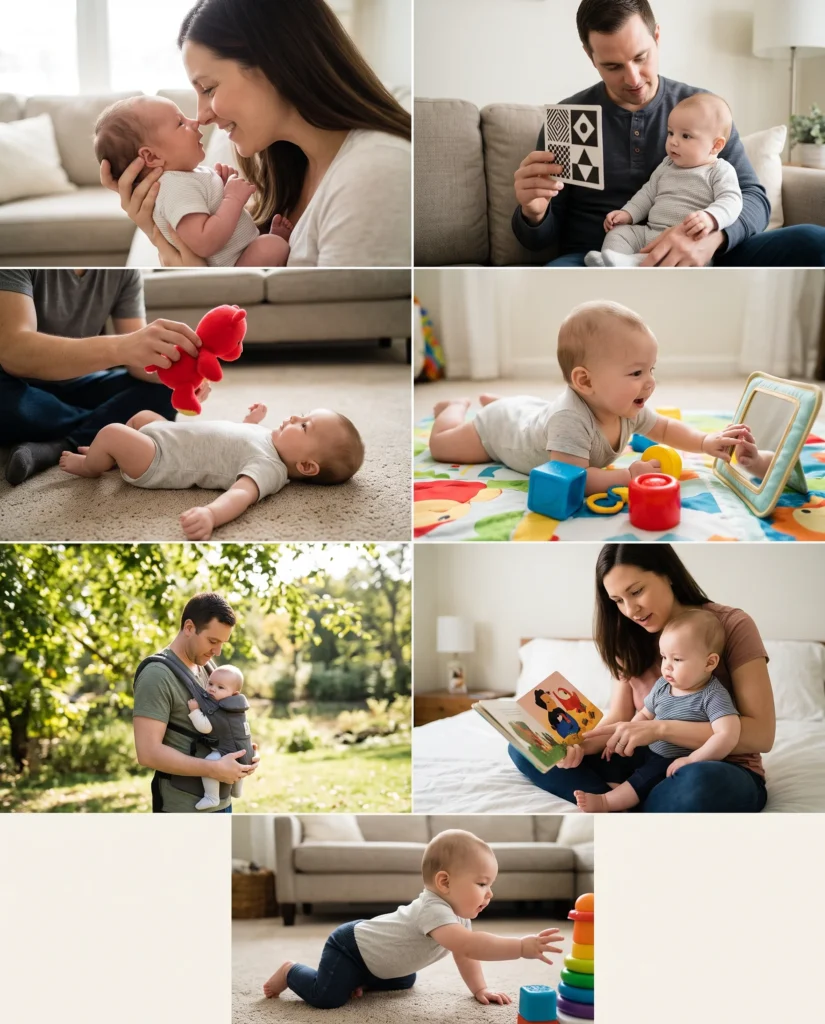
Hold your baby about 8 to 12 inches from your face. Talk, sing, and make slow, gentle expressions. Your face is the best “toy” they have.
Step 2: Use High-Contrast Cards
Show black-and-white or bold-pattern cards for a minute or two at a time. Watch for signs your baby is interested, like staring or going quiet. If they turn away, that’s a sign to take a break.
Step 3: Add Slow Movement (2 to 4 Months)
Move a brightly colored object slowly from side to side, about a foot away. Let your baby’s eyes follow it. This builds eye tracking, a key vision skill.
Step 4: Introduce Bold Colors (3 to 6 Months)
Offer toys in strong, bright colors. Rotate them every few days so things stay fresh. Add a baby-safe mirror too. Pathways.org lists activities like these as helpful ways to support vision.
Step 5: Get Outside
Take short walks. Natural light, moving leaves, and changing scenery give your baby’s eyes plenty to practice on. Just keep direct sun out of their eyes.
Step 6: Read Together (All Year Long)
Choose picture books with big, clear images and bright colors. Point, name, and talk. Reading builds vision and language at the same time.
Step 7: Let Them Reach and Grab (6 to 12 Months)
Place colorful, safe toys just out of reach so your baby has to look, crawl, and grab. This trains hand-eye coordination and depth perception.
Signs of Baby Vision Problems: When to Call the Doctor
Most babies develop vision without trouble. Still, it helps to know what to watch for. Talk to your pediatrician if you notice:
One or both eyes constantly turning inward or outward after the first couple of months
Your baby doesn’t follow objects or faces by around 3 to 4 months
Frequent squinting, or rubbing eyes when they aren’t tired
Unusual sensitivity to light, or constant tearing
A white or cloudy look in the pupil
The AAO says eye or vision problems can delay development, so early screening matters. Pediatricians check vision at regular well-baby visits, and Pathways.org notes that a first eye exam by an eye doctor is recommended between 6 and 12 months.
What About Color Blindness?
This worry comes up a lot. Here’s the honest answer: it’s very hard to tell if a baby is color blind. Most families don’t find out until the child is old enough to name colors. If color blindness runs in your family, mention it to your pediatrician. They can guide you on when testing makes sense.
Premature babies: if your baby arrived early, judge milestones by their due date, not their birthday. The AAO recommends this approach.
Baby Color Vision Myths vs. Facts
Let’s clear up a few common mix-ups.
Myth: Babies see only black and white. Fact: They see some color from early on, but it’s faint. It becomes much richer over the first 5 months.
Myth: Bright toys will make my baby smarter overnight. Fact: Colorful play helps, but it works best alongside talking, cuddling, and everyday interaction.
Myth: If my baby ignores colors at 2 months, something is wrong. Fact: That’s usually normal. Their eyes are still learning to focus and team up.
Myth: You must buy special gear for good vision. Fact: Your face, a few simple toys, and a walk outside do a lot of the work.
Baby Color Toys and Visual Stimulation: Choosing With Confidence
Toys can help, as long as they match your baby’s stage. Look for products that offer:
Bold, high-contrast designs for the early months
Bright primary colors as your baby grows
Safe, non-toxic materials with no small parts
Different textures and shapes, so play stays interesting
Easy cleaning, because everything goes in the mouth
Why this matters: A well-chosen toy gives your baby a clear, comfortable way to practice focusing, tracking, and telling colors apart, without overwhelming little eyes.
Infant Eye Development Tips: A Simple Daily Checklist
Keep this handy:
✅ Hold your baby close for face-to-face time
✅ Show a few bold patterns or colors, a minute or two at a time
✅ Move objects slowly so your baby can track them
✅ Rotate toys every few days
✅ Spend a little time outdoors
✅ Read a picture book
✅ Attend all well-baby visits, and schedule that first eye exam between 6 and 12 months
✅ Write down anything that worries you and share it with your doctor
Final Thoughts: When Can Infant See Color?
So, when can infant see color? The best answer is: a little from the very start, much more by 3 to 4 months, and fully by around 5 months, with steady improvement all year. Your baby’s world gradually shifts from fuzzy shapes to a vivid, detailed picture.
Remember Marcus and his rainbow mobile? A few months later, his daughter was reaching for that very same mobile and giggling at the red and yellow shapes. The toy hadn’t changed. Her eyes had.
You can’t speed up nature, but you can give your baby plenty of loving, colorful, close-up moments to practice. And if anything ever worries you, your pediatrician is just a call away.
Frequently Asked Questions
Can newborns see color at all?
Yes, but only faintly. Their color vision is muted and improves over time.
At what age do babies see full color?
Most reach full-color vision around 4 to 6 months, though refinement continues through the first year.
What color do babies see first?
Red is often the first color babies notice.
Do I need black-and-white toys?
They’re helpful in the first weeks because of the strong contrast, but they aren’t required. Your face works wonderfully.
When should my baby have a first eye exam?
Between 6 and 12 months, according to Pathways.org, plus regular checks at well-baby visits.