
Picture a woman I’ll call Amira. She’s 33, and she’s just had both fallopian tubes removed after a serious infection. She walks out of the hospital relieved, then lies awake that night with one question: “Will I ever be a mom?”
If you’re asking the same thing, take a breath. The honest answer has two parts. The first part is hard. The second part is hopeful. Let’s walk through both, in plain words.
Natural Pregnancy Without Fallopian Tubes: Is It Really Possible?
Here’s the short version. If you have Natural Pregnancy Without fallopian tubes at all, you can’t get pregnant through sex alone. Without functioning tubes, the sperm and egg can’t meet, so natural conception is unlikely. Doctors say the same thing in nearly every source. Loma Linda’s fertility center says IVF is the only way to become pregnant after losing both tubes. thomsonmedicallomalindafertility
Now the hopeful part. Having no tubes doesn’t mean you can’t have a baby. Modern medicine has a workaround, and it works for many women. It’s called in vitro fertilization (IVF), and it skips the tubes completely.
Also, “no tubes” and “one tube” are very different situations, and we’ll cover both below.
How Fallopian Tubes Work: Why Nature Needs Them
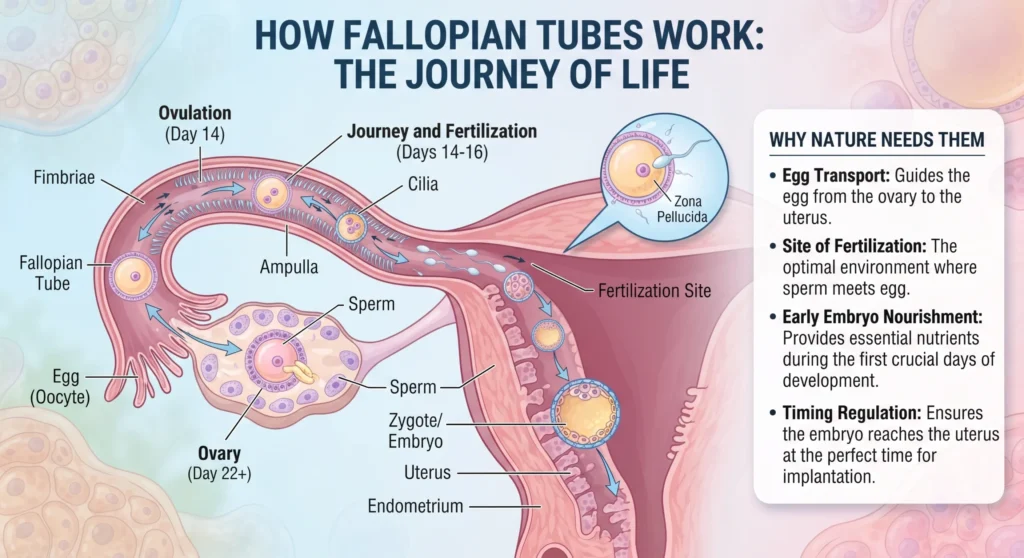
Before we talk about workarounds, let’s understand what the tubes do. Your fallopian tubes are two thin passages that link your ovaries to your uterus. Think of them as a quiet little highway with a meeting spot in the middle.
Here’s the natural process:
- An ovary releases an egg (this is ovulation).
- The tube catches the egg and gently moves it along.
- Sperm swim up and meet the egg inside the tube.
- The fertilized egg travels down into the uterus.
- It attaches to the womb lining and starts to grow.
So the tube is more than a pipe. It’s where egg and sperm actually meet. Remove both tubes, and that meeting spot disappears. That’s why natural conception stops.
One more point many people miss: having no tubes doesn’t stop ovulation. Without tubes, a woman can still release eggs unless another problem affects ovulation. Your ovaries and uterus keep working. That’s exactly why IVF is such a good fit. invitra
Pregnancy With One Fallopian Tube: The Good News
Maybe you’ve lost only one tube. If so, you can relax a little. With just one tube removed, you can still conceive naturally as long as the remaining tube works well. scienceinsights
Here’s how that can happen. The ovary on the side that still has a tube releases an egg, and that egg travels normally. In some women, the egg from the “empty” side can even be picked up by the tube on the other side, though this is less common.
Of course, one tube doesn’t mean there are no risks. If the remaining tube is scarred or partly blocked, getting pregnant can take longer. A doctor can check it with a simple imaging test. If you’ve been trying for 12 months (or 6 months if you’re 35 or older), it’s smart to book a fertility check.
Pregnancy After Salpingectomy: When Both Tubes Are Gone
A salpingectomy is surgery to remove a tube. A bilateral salpingectomy removes both. Women have this surgery for many reasons:
- Severe infection or scarring
- Fluid-filled, damaged tubes
- A past ectopic pregnancy
- Tube cancer (rare)
- Permanent birth control, or to lower certain cancer risks
Let me tell you about a woman I’ll call Dana. Years ago, she chose to have her tubes removed because she was done having children. Ten years later, life changed. She remarried and wanted a baby. Dana felt crushed at first, as if she’d closed a door forever.
But she hadn’t. Her ovaries still worked. Her uterus was healthy. With IVF, her doctor collected her eggs, fertilized them in a lab, and placed an embryo straight into her womb. (Dana is an illustrative example, not a real patient.)
That’s the key idea. Pregnancy after salpingectomy is possible. It just happens through IVF instead of through sex.
Tubal Factor Infertility: Why Tubes Get Blocked or Damaged
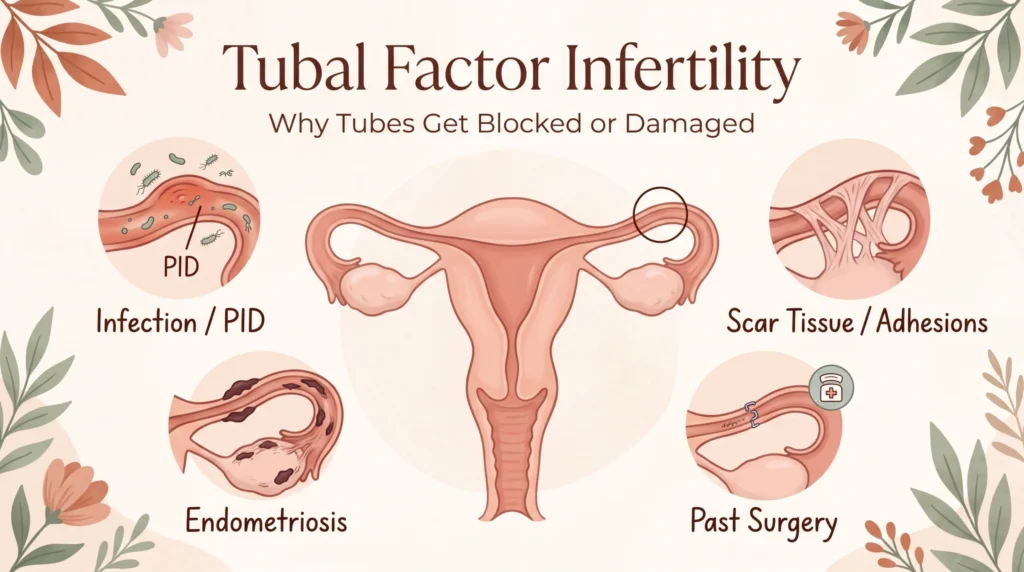
Doctors use the term tubal factor infertility when blocked or damaged tubes are the main reason a woman can’t conceive. It’s common, and it has many causes:
- Pelvic inflammatory disease (PID), often from untreated infections like chlamydia or gonorrhea
- Endometriosis
- Scar tissue from past surgery
- Fibroids
- A previous ectopic pregnancy
Severe or repeated infections can scar the tubes, and endometriosis, fibroids, or surgical scarring can also stop them from working. romper
Many women don’t know their tubes are blocked. There may be no pain and no warning signs. A test called a hysterosalpingogram (HSG) can show whether the tubes are open. If you’ve been trying for a while without luck, ask your doctor about it.
Hydrosalpinx and IVF Success: Why Removing a Damaged Tube Can Help
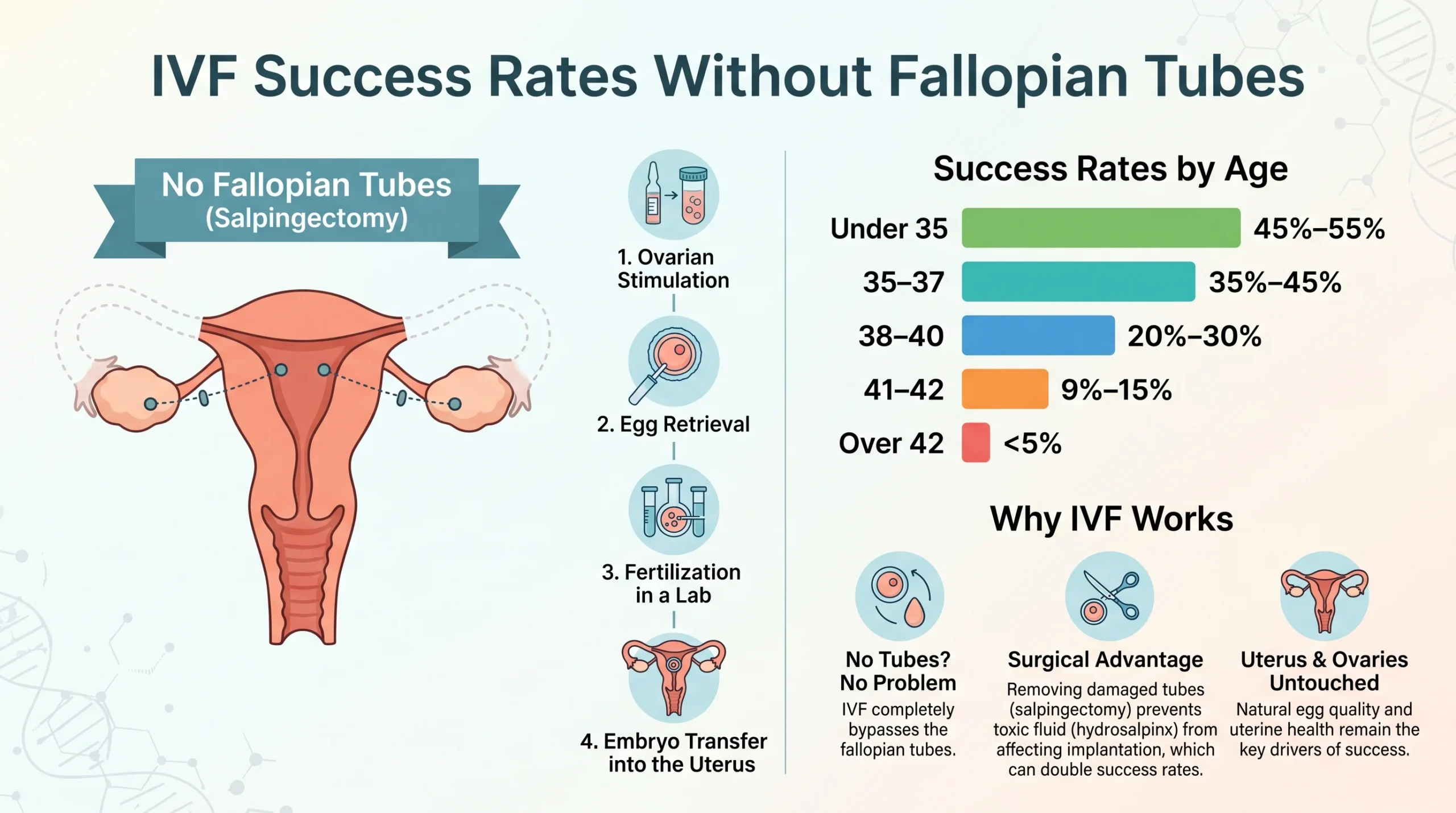
This one surprises people. Sometimes a damaged tube fills with fluid. Doctors call it a hydrosalpinx. That fluid can leak back into the uterus and make it harder for an embryo to attach.
So here’s a twist. When tubes are removed because they’re damaged or fluid-filled, IVF results can actually improve, because the fluid no longer interferes with implantation. A clinic in Tampa also notes that doctors sometimes recommend removing a blocked tube even before IVF. That’s one reason removal is sometimes advised ahead of treatment. scienceinsightsfloridafertility
If your tubes were removed because they were healthy and you chose sterilization, your chances depend on the same things as anyone else’s: age, egg quality, and overall reproductive health.
IVF Without Fallopian Tubes: How It Bypasses the Problem
IVF sounds complicated, but the idea is simple. It does the tubes’ job in a lab. Your eggs are collected straight from the ovary, fertilized in the lab, and the embryo is moved back into your uterus. invitra
Some clinics add a step called ICSI, where one sperm is placed directly into one egg. This is especially useful when sperm quality is also a concern. Both IVF and ICSI work without tubes, since neither needs them. thomsonmedical
What about IUI (intrauterine insemination)? It doesn’t work without tubes, because the egg and sperm still have to meet inside them. So IUI is not an option if both tubes are gone. thomsonmedical
Step-by-Step Guide: How to Get Pregnant After Your Tubes Are Removed
Here’s a simple roadmap. Every case is different, so your doctor will adjust it for you.
Step 1: Give yourself time to heal. Most doctors suggest waiting a few months after surgery before starting treatment.
Step 2: Book a fertility consultation. Bring your surgery notes, scan results, and any test reports. The more your doctor sees, the better the plan.
Step 3: Get your baseline tests. These usually include an ultrasound to check your uterus and ovaries, and blood tests that show your egg supply (like AMH). Your partner’s semen test comes into play too.
Step 4: Ovarian stimulation. You take hormone medicine for around 10 days so your ovaries produce several eggs. Your clinic monitors you with scans.
Step 5: Egg collection. A short procedure, done under sedation, collects the eggs.
Step 6: Fertilization in the lab. The eggs meet sperm, through standard IVF or ICSI. Embryologists watch them grow for several days.
Step 7: Embryo transfer. A chosen embryo is placed in your uterus through a thin soft tube. It’s quick, and most women find it easier than they feared. See the embryo transfer basics for more detail.
Step 8: The waiting period. About two weeks later, you take a pregnancy test. If it’s positive, your clinic follows up with early scans.
Some people also freeze extra embryos for later. That can mean a second try without repeating the whole process.
Ectopic Pregnancy Risk After Tube Removal: What to Watch For
Here’s a detail worth knowing. Even without tubes, a small risk of an ectopic pregnancy remains with IVF. Small bits of leftover tube tissue can occasionally catch an embryo. scienceinsights
An ectopic pregnancy happens outside the uterus and needs urgent care. Call your doctor or go to an emergency room right away if you have:
- Sharp pain on one side of your belly
- Vaginal bleeding after a positive test
- Dizziness or shoulder pain
Don’t panic. Your clinic will schedule early scans to confirm the pregnancy is in the right place. This is exactly why good monitoring matters.
IVF Success Rates Without Fallopian Tubes: What to Expect
Let’s keep this real. IVF isn’t magic, and no honest clinic can promise a baby. But the numbers are encouraging for many women with tube problems, because the tubes were the only issue.
The main factors that shape your chances are:
- Your age (the biggest factor)
- Egg quality and supply
- Your partner’s sperm quality
- Your uterus and general health
- The clinic’s lab quality
Clinics publish their own rates, and you should always ask to see them. For example, IGIN in Spain reports an IVF-ICSI pregnancy rate of 79%, against a 34% national average, with data audited by the Spanish Fertility Society. These are the clinic’s own figures, and rates vary by age and case, so treat them as a starting point for questions, not a promise.
Choosing a Fertility Clinic: Why Confidence Matters
You can read every article online, but the real decision is who walks the road with you. In my view, a clinic worth trusting does these things:
- Explains your options clearly, without rushing you
- Shares success rates openly
- Gives you clear, written pricing
- Offers emotional support, not just medical care
- Monitors you closely after transfer
Here are three clinics worth a look. Each has a different strength.
Thomson Medical in Singapore is a private healthcare group focused on women’s and children’s care for more than 45 years, with over 65 clinics. Their team has also published a clear guide on IUI and fallopian tubes, which shows how openly they explain options.
IGIN (Instituto IGIN) in Spain offers a free fertility study with a private consultation, an ultrasound, and a review of your history. They advertise all-inclusive fixed prices, so there are fewer surprise costs.
Fertility Madrid lists IVF starting from €4,995 on its site, offers a free first consultation, and has an emotional support unit with a coach. That last point matters more than people expect. This journey can be tough, and having someone in your corner helps.
If you have no tubes and want a baby, don’t wait for a miracle on the natural path. Pick a clinic, book the first visit, and ask every question you have. That first appointment is usually free or low-pressure, and it turns a vague worry into a real plan. You’ll leave with answers, a timeline, and next steps. Many women say the relief of having a plan is the first thing that eases the stress.
Final Thoughts: Your Path Is Different, Not Closed
Let’s go back to Amira, the woman from the start. She didn’t get a “natural” pregnancy. She got a plan, a team, and an embryo transfer. And one day, she got a positive test. (Amira is an illustrative example.)
Natural pregnancy without fallopian tubes isn’t realistic. But pregnancy without fallopian tubes absolutely is, through IVF. Your ovaries, your uterus, and your hope are still very much in the game.
So here’s your next step: book a consultation with a clinic you trust, bring your medical records, and ask them to build your plan. The sooner you start, the sooner you’ll know your real options.
Frequently Asked Questions
Can I get pregnant naturally with no fallopian tubes?
No. Without any working tubes, egg and sperm can’t meet. IVF is the way forward.
Can I get pregnant with just one tube?
Yes, if that tube is healthy and open.
Will I still get my period without tubes?
Yes. Your uterus and ovaries still work, so your cycle usually continues.
Does having my tubes removed hurt my IVF chances?
Not necessarily. If the tubes were damaged or fluid-filled, removal can help. If you had them removed as birth control, your odds are similar to other women your age.
How long after surgery can I start IVF?Is IVF safe?
Often within a few months, once you’ve healed. Your doctor will tell you what’s right for you.
It’s widely used and well studied, but it has risks, including ectopic pregnancy and the effects of fertility drugs. Your doctor will explain them.