Importance of Teamwork for Achieving Goals for Children: A Complete Guide for Parents
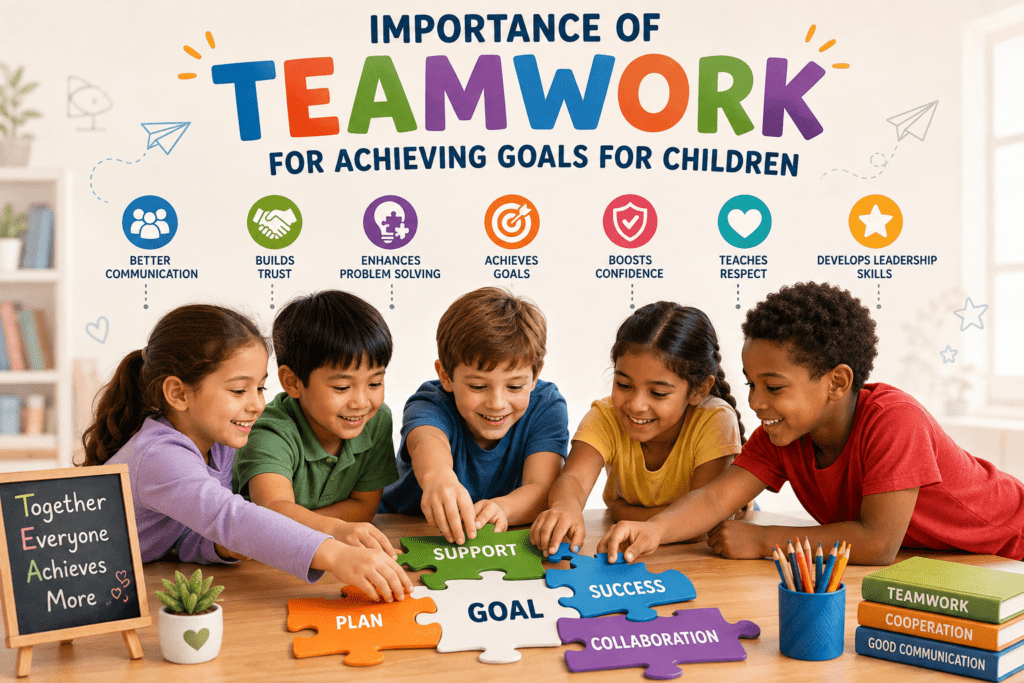
Children learn many important lessons while growing up, but some lessons cannot be learned from books alone. Learning how to work with others is one of them. Whether children are building a tower with blocks, completing a school project, playing a team sport, or helping with a family task, teamwork teaches them how to communicate, share responsibilities, solve problems, and work toward a common goal.
Understanding the importance of teamwork for achieving goals for children can help parents and teachers prepare children for challenges at school, at home, and later in life.
Teamwork does not mean that every child has to agree with everyone else. Instead, it teaches children how to listen to different ideas, respect other people, contribute their own strengths, and find solutions together.
Research and guidance from organizations such as UNICEF and the National Association for the Education of Young Children (NAEYC) emphasize the value of play, social development, cooperation, communication, and collaborative experiences in children’s development. UNICEF notes that play can help children build social skills, relationships, resilience, leadership, and problem-solving abilities.
So, how can parents help children become better team players? And why does teamwork matter so much when children are trying to achieve their goals?
Let’s explore it step by step.
Why Is Teamwork Important for Children?
Importance of teamwork for achieving goals for children because it teaches them how to work with people who may think, behave, or communicate differently from them.
Imagine a group of four children building a large tower from blocks. One child wants to build the base, another wants to make the top, and another wants to choose the colors. At first, they may argue about what to do.
But eventually, they have to communicate.
They might say:
“You build the bottom while I make the top.”
“Let’s use your idea first.”
“Can you help me with this part?”
This simple activity teaches lessons that can be useful throughout life.
Children begin to understand that a shared goal sometimes requires patience, communication, compromise, and cooperation.
According to UNICEF, play gives children opportunities to build connections, develop social skills, practice leadership, navigate relationships, and deal with social challenges.
Teamwork also helps children understand that they do not have to accomplish everything alone.
For example, a child who struggles with drawing may be excellent at explaining ideas. Another child may be good at organizing materials. A third child may be confident speaking in front of others.
When they work together, each child can contribute something valuable.
This teaches an important lesson:
Everyone has strengths, and successful teams know how to use those strengths together.
Why Is Teamwork Important for Achieving Goals?
Importance of teamwork for achieving goals for children because people can combine their skills, ideas, time, and effort to accomplish something that may be difficult to complete alone.
Children can learn this idea through simple everyday experiences.
Suppose a child wants to create a small vegetable garden at home. Instead of doing everything alone, the family can divide the work.
One person prepares the soil.
Another plants the seeds.
Someone else waters the plants.
The child can keep track of the growth.
The family is working toward one shared goal.
This teaches children that goals become easier to manage when responsibilities are divided.
Teamwork turns a big goal into smaller tasks
Sometimes a goal can feel too large for a child.
For example:
Goal: Prepare a school science project.
Instead of saying, “Finish your project,” parents can help the child break it into smaller steps:
- Choose a topic.
- Find basic information.
- Make a simple plan.
- Collect materials.
- Create the project.
- Practice explaining it.
- Present it to the class.
When several children work together, each person can take responsibility for one part.
This develops planning skills, responsibility, organization, communication, and problem-solving.
UNICEF’s guidance on cooperation and teamwork also highlights skills such as listening to others’ ideas, recognizing different strengths, finding solutions together, compromising, and developing respectful relationships.
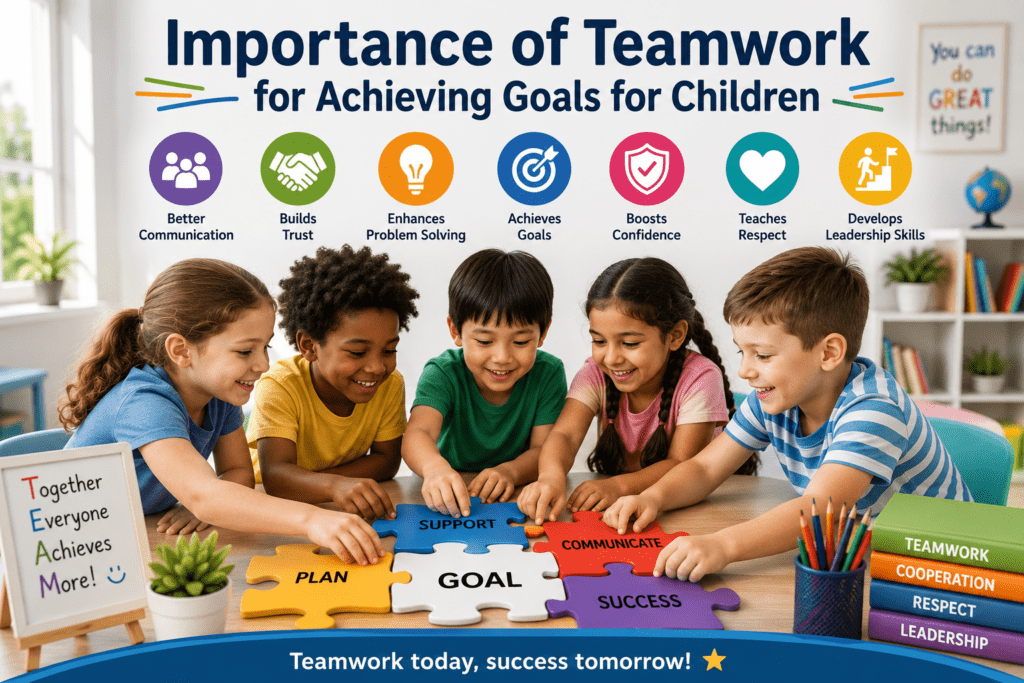
What Are the 7 Benefits of Teamwork?
There are many advantages to teamwork, but seven benefits are especially valuable during childhood.
1. Teamwork Builds Communication Skills
Good communication is one of the most important teamwork skills children can develop.
When children work together, they have to explain what they mean and listen to what others are saying.
For example, imagine two children working on a puzzle.
One says:
“I think this piece goes here.”
The other responds:
“I don’t think so. Look at the picture.”
They may disagree, but they have an opportunity to discuss the problem.
Through these experiences, children learn how to:
- Express their ideas
- Listen carefully
- Ask questions
- Explain their opinions
- Give helpful feedback
- Understand other people’s viewpoints
These communication skills become increasingly important as children grow.
NAEYC guidance on children’s social development emphasizes opportunities for children to work together, include one another, make friendships, and resolve disagreements and Importance of teamwork for achieving goals for children .
2. Teamwork Teaches Children Responsibility
When children become part of a team, they learn that their actions affect other people.
Imagine three children preparing a presentation.
One child agrees to create the poster.
Another agrees to collect information.
The third agrees to practice the presentation.
If one child does not complete their task, everyone may be affected.
This teaches children that being part of a team means keeping promises and completing responsibilities.
Parents can strengthen this lesson by giving children age-appropriate responsibilities at home.
For example:
- Putting toys away together
- Setting the dinner table
- Organizing books
- Preparing materials for a family activity
- Helping with simple household tasks
The goal is not perfection.
The goal is helping children understand:
“My contribution matters.”
3. Teamwork Develops Problem-Solving Skills
Children will not always agree with each other.
And that is actually useful.
Disagreements give children opportunities to learn how to solve problems respectfully.
For example, two siblings may both want to use the same toy.
A parent could immediately decide who gets it.
However, another approach is to ask:
“How can we solve this together?”
The children might decide to take turns.
They might create a timer.
Or they may find another activity they can do together.
This teaches children that a problem does not always need a winner and a loser.
Sometimes, the best solution is one that works reasonably well for everyone.
UNICEF notes that collaborative play can help children cooperate, communicate effectively, and resolve conflicts.
4. Teamwork Builds Confidence
Some children are naturally comfortable speaking in front of others.
Others are quieter.
Team activities can give quieter children opportunities to participate without putting them under too much pressure.
For example, a child who does not want to give the entire presentation might begin by helping prepare the slides or explaining one small section.
Over time, these small experiences can build confidence.
The child begins to think:
“I have something useful to contribute.”
That feeling of belonging can be powerful.
A child does not have to be the loudest person in a group to be an important team member.
5. Teamwork Teaches Empathy and Respect
Children need to learn that other people have different feelings, ideas, abilities, and experiences.
Teamwork naturally creates opportunities to practice this.
A child may discover that a teammate is having difficulty with a task.
Instead of laughing or ignoring them, the child can offer help.
They may say:
“Do you want me to show you?”
This simple interaction teaches empathy, kindness, patience, and respect.
Children also learn that being different does not mean being less valuable.
Every team member can contribute in a different way.
6. Teamwork Encourages Creativity
When several children work together, they bring different ideas to the same problem.
One child may think of an unusual solution.
Another may improve the idea.
A third may notice a problem that others missed.
This combination can lead to creative results.
For example, children asked to build a bridge using paper may initially create a simple flat structure. One child may suggest folding the paper. Another may suggest using several layers.
Suddenly, the team has a stronger design.
Teamwork gives children opportunities to think, experiment, compare ideas, and create solutions together.
UNICEF describes play as an important way for children to explore possibilities, make choices, use imagination, and develop problem-solving and other transferable skills.
7. Teamwork Prepares Children for Real Life
Perhaps the biggest benefit is that teamwork is a lifelong skill.
Children eventually become students, coworkers, friends, parents, community members, and leaders.
In almost every part of adult life, people need to work with others.
They may need to:
- Complete group projects
- Communicate with coworkers
- Solve problems
- Share responsibilities
- Negotiate disagreements
- Support other people
- Work toward shared goals
Teaching teamwork during childhood gives children a foundation they can continue building throughout their lives.
UNICEF specifically identifies cooperation and teamwork as competencies that can help adolescents maintain healthy relationships and participate positively in their communities.
Why Is Teamwork Important in Five Lines?
If you need a short explanation for a child, student, teacher, or parent, here is a simple five-line answer:
Importance of teamwork for achieving goals for children ,teaches children how to work together toward a shared goal. It helps them communicate clearly and listen to other people’s ideas. It teaches responsibility because every team member has a role to play. Teamwork also develops problem-solving, patience, empathy, and respect. Most importantly, it helps children understand that working together can achieve more than working alone.
How Parents Can Teach Teamwork at Home
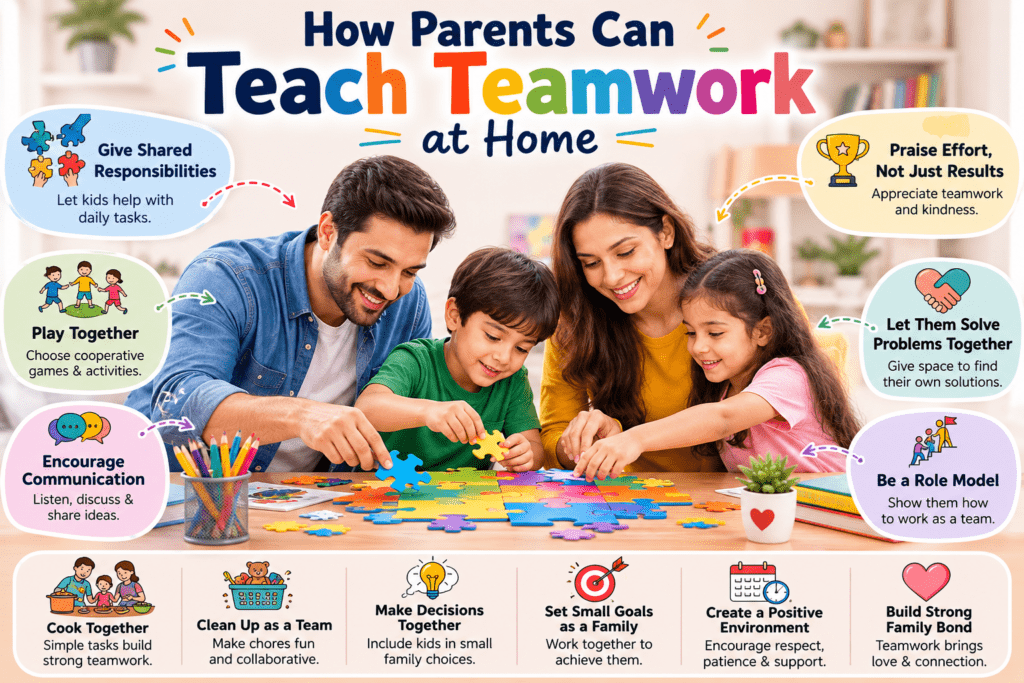
Importance of teamwork for achieving goals for children in that way ,Parents do not need expensive programs or complicated activities to teach teamwork.
Everyday family life provides many opportunities.
1. Give Children Shared Responsibilities
Instead of giving every child a completely separate task, occasionally create a shared task.
For example:
“Let’s clean the playroom together in ten minutes.”
One child can collect books.
Another can put toys into boxes.
A parent can organize the shelves.
Now everyone is working toward the same goal.
2. Play Cooperative Games
Choose games where children need to cooperate instead of simply competing against each other.
Ideas include:
- Building-block challenges
- Puzzles
- Team treasure hunts
- Drawing together
- Simple cooking projects
- Family gardening
- Group storytelling
- Relay activities
- Building challenges
UNICEF’s science of play resources explain how play can support children’s learning, problem-solving, expression, and relationships.
3. Let Children Make Decisions Together
Instead of solving every problem for them, ask questions.
Try:
“What do you think we should do?”
“How can you share this?”
“What would be fair?”
“What is another solution?”
This encourages independent thinking and collaborative problem-solving.
4. Praise Cooperation, Not Just Winning
If children only receive praise when they win, they may begin to believe that success means beating others.
Instead, praise behaviors such as:
“I liked how you listened to your brother.”
“You did a great job helping your teammate.”
“You kept trying even when the group had a problem.”
This teaches children that good teamwork itself is an achievement.
A Step-by-Step Guide to Teaching Children Teamwork
If your child struggles with group activities, start small.
Step 1: Choose a Simple Shared Goal
Pick something that can be completed within a short period.
For example:
“Let’s build a cardboard house together.”
Step 2: Divide the Responsibilities
Ask:
“Who wants to do which part?”
Let children choose where possible.
Step 3: Explain Why Everyone Matters
Tell them:
“The house will only be finished if everyone helps.”
This helps children see the connection between individual effort and group success.
Step 4: Encourage Communication
Remind children to ask questions instead of grabbing materials or giving orders.
Teach phrases such as:
- “Can I help?”
- “What do you think?”
- “Can we take turns?”
- “I have an idea.”
- “Let’s try it together.”
- “I’m having trouble. Can you help me?”
Step 5: Allow Small Problems
Do not rush to fix every disagreement.
If children can safely solve a small problem themselves, give them the opportunity.
Step 6: Reflect Afterward
When the activity is finished, ask:
“What worked well?”
“What was difficult?”
“How did you solve the problem?”
“What would you do differently next time?”
This reflection helps turn an ordinary activity into a learning experience.
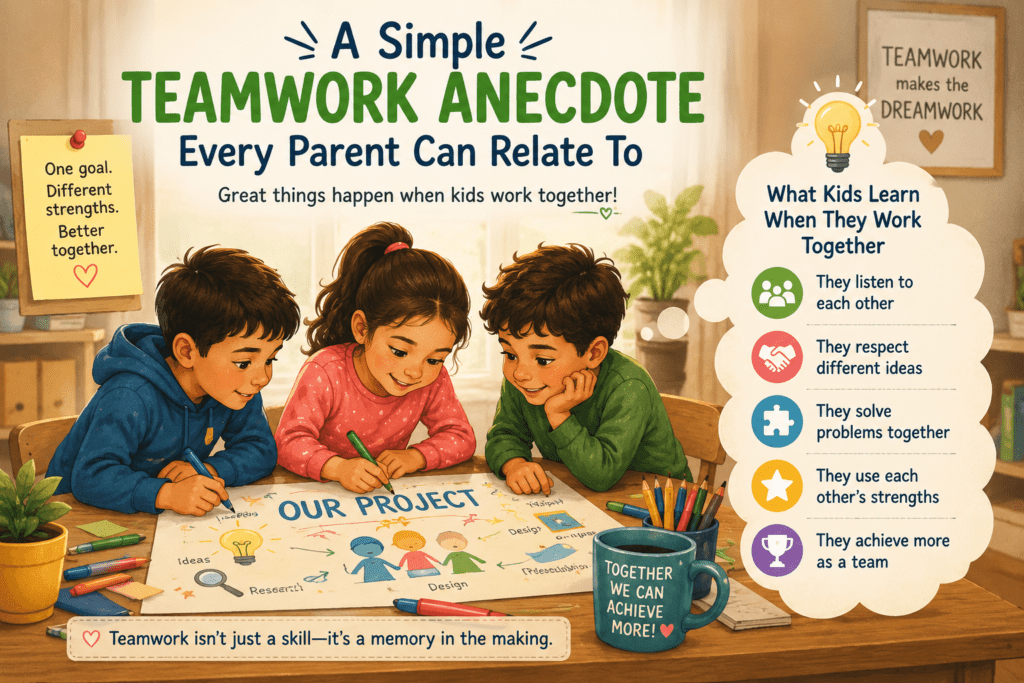
A Simple Teamwork Anecdote Every Parent Can Relate To
Consider a child named Sam who was working on a school poster with two classmates.
Sam wanted to make the entire poster himself because he believed his idea was the best.
His classmates became frustrated.
Instead of helping, they stopped participating.
The teacher then asked Sam a simple question:
“Do you want the poster to be your poster or your team’s poster?”
That question changed everything.
Sam realized that having the best idea was not enough.
He needed to listen.
One classmate was good at drawing, another was good at finding information, and Sam was good at explaining the topic.
Once everyone had a role, the project became easier and more enjoyable.
The children did not just finish a poster.
They learned an important lesson:
A successful team does not require everyone to do the same thing. It requires everyone to contribute.
Teamwork and Goal Setting for Children
Teamwork becomes even more powerful when children learn how to set clear goals.
A goal gives the team something specific to work toward.
For example, instead of saying:
“Let’s get better at reading.”
A child could set a more specific goal:
“We will read one short story together every evening this week.”
Then the children can divide responsibilities.
One child chooses the story.
Another reads the first page.
Another asks questions about the story.
Parents can help children make goals specific, realistic, and easy to track.
This teaches children that achieving goals is usually a process rather than one big action.
The Role of Teachers in Building Teamwork
Parents are not the only people who can teach teamwork.
Teachers play an important role too.
Classroom activities such as group projects, cooperative games, role-play, discussions, and shared problem-solving tasks can give children regular opportunities to practice working with others.
NAEYC explains that children’s social development includes learning to work together, include others, make friendships, and resolve disagreements.
Recent education work in Pakistan also highlights activity-based learning, group work, project-based learning, and teamwork as ways to encourage children’s critical thinking and creativity.
The best classroom teamwork activities are structured enough to give children direction but flexible enough to allow them to make choices.
Teamwork Does Not Mean Avoiding Individual Goals
It is important to remember that teamwork and independence are not opposites.
Children need both.
A child should learn how to complete tasks independently while also understanding when cooperation is helpful.
For example, a child might first try solving a math problem alone. If the problem remains difficult, working with a classmate may help.
Similarly, a child might write their own part of a group project but then work with classmates to combine everyone’s contributions.
The goal is balance:
“I can do things on my own, and I also know how to work with others.”
That is a powerful mindset for children to develop.
How to Handle Teamwork Problems
Teamwork will not always be easy.
Children may argue.
Someone may refuse to share.
One child may try to control everything.
Another may stay quiet.
These situations are normal opportunities for learning.
If one child dominates
Ask:
“How can everyone get a chance to contribute?”
If children argue
Ask:
“What does each person want, and is there a solution that can work for both?”
If one child refuses to participate
Ask:
“Which part would you feel comfortable helping with?”
If someone makes a mistake
Encourage the team to ask:
“What can we learn from what happened?”
The aim is not to create perfect teams.
The aim is to help children learn how to handle imperfect situations respectfully.
Teamwork Activities for Different Ages
For Young Children
Try:
- Building blocks together
- Simple puzzles
- Cleaning up toys as a team
- Drawing one large picture
- Pretend-play activities
- Simple cooking tasks
Young children learn especially well through hands-on play. UNICEF emphasizes that play supports social, emotional, cognitive, and physical development.
For School-Age Children
Try:
- Group science projects
- Team sports
- Family gardening
- Cooking together
- Board games
- Treasure hunts
- Group art projects
- Building challenges
For Older Children and Teens
Try:
- Community projects
- Group presentations
- Volunteer activities
- Team sports
- Peer study groups
- School clubs
- Planning family events
Older children can also take more responsibility for planning, leadership, communication, and decision-making.
Teamwork, Sports, and Children’s Development
Sports are another natural way to teach teamwork.
When children participate in team sports, they may learn how to communicate during a game, support teammates, follow rules, handle disappointment, and work toward a shared result.
UNICEF reports that participation in sport can contribute to children’s learning and skills development, including leadership, empowerment, and self-esteem.
However, children do not have to play competitive sports to learn teamwork.
A simple family game, group activity, or cooperative project can provide valuable practice too.
What Parents Should Avoid When Teaching Teamwork
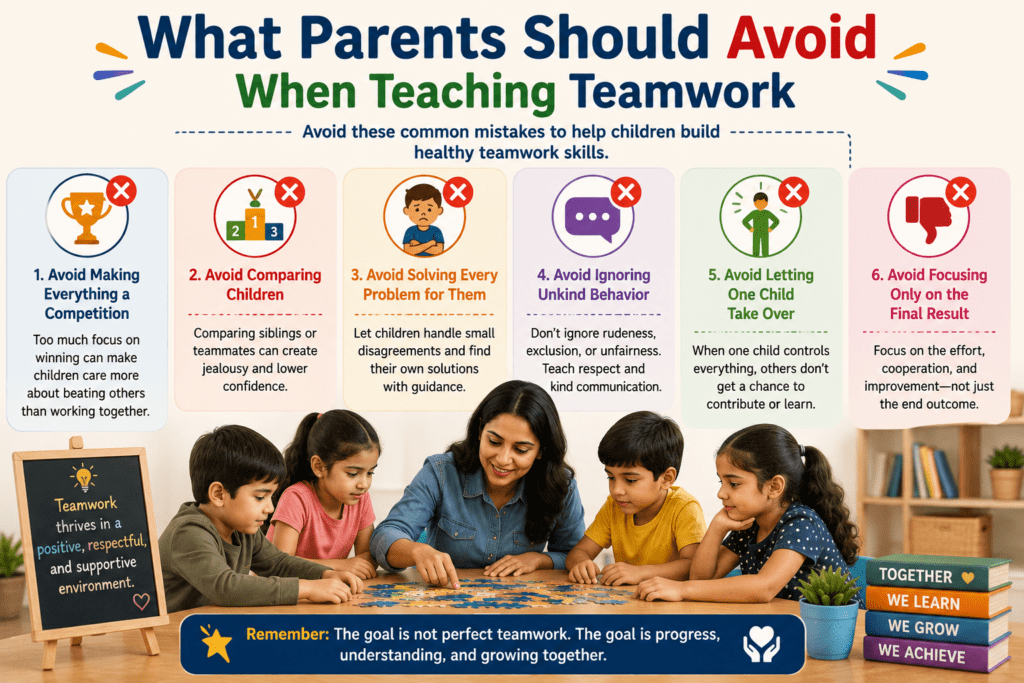
While encouraging teamwork, parents should avoid turning every activity into a competition.
Constant competition can make some children focus more on winning than cooperating.
Also avoid comparing siblings by saying:
“Look how much better your brother is at teamwork.”
Instead, focus on progress.
Say:
“Yesterday you had trouble sharing the materials. Today you took turns really well.”
This helps children recognize their own improvement.
Parents should also avoid solving every disagreement immediately.
Whenever it is safe and appropriate, give children space to practice finding solutions.
How Teamwork Helps Children Achieve Bigger Goals
The importance of teamwork for achieving goals for children becomes especially clear when the goal is larger than one person can easily handle.
Think about a school play.
There are actors, costume helpers, people preparing the stage, students working on decorations, and teachers organizing the event.
No single person creates the entire performance.
The final result depends on many people completing different responsibilities.
The same principle applies to children’s everyday lives.
A successful family trip requires planning.
A school project requires cooperation.
A sports game requires coordination.
A community activity requires participation.
A classroom activity requires listening and sharing.
Children gradually learn that large achievements are often built from many small contributions.
Final Thoughts: Helping Children Become Better Team Players
The importance of teamwork for achieving goals for children goes far beyond school projects and sports.
Teamwork helps children understand how relationships work.
It teaches them to listen when someone has a different opinion. It shows them how to share responsibilities. It gives them opportunities to solve problems, support others, and recognize their own strengths.
Most importantly, teamwork teaches children that success does not always mean doing everything yourself.
Sometimes success means saying:
“Let’s do it together.”
Parents can start with simple activities at home. Build something together. Cook together. Play a cooperative game. Work on a small family project. Let children make decisions. Allow them to experience small disagreements and guide them toward respectful solutions.
These moments may look ordinary, but they can become important lessons.
As children grow, the ability to communicate, cooperate, solve problems, respect others, and work toward shared goals can become one of their most valuable life skills.
The best part is that teamwork does not have to be taught through long lectures.
Children can learn it through play, family activities, school projects, sports, and everyday experiences.
And when children learn that their contribution matters while also learning to value the contributions of others, they are not simply becoming better team members.
They are building the skills they need to become confident, responsible, caring, and capable people.
Helpful Parenting Resources
Parents looking for additional information about child development, play, learning, and social-emotional skills can explore:
- UNICEF Parenting for child development and parenting resources.
- UNICEF Early Childhood Development for information about children’s early development.
- NAEYC Family Resources for information about children’s learning and development.
- UNICEF’s cooperation and teamwork guidance for additional information about teamwork and cooperation skills.
Frequently Asked Questions
Why is teamwork important for children?
Teamwork helps children develop communication, cooperation, responsibility, empathy, problem-solving, confidence, and respect. It also teaches them how to contribute to a shared goal while appreciating the strengths of other people.
Why is teamwork important for achieving goals?
Teamwork allows people to combine their different skills and divide responsibilities. For children, this makes large tasks easier to understand and teaches them how individual contributions can help a group achieve a shared goal.
What are the 7 benefits of teamwork?
The seven major benefits discussed in this article are:
Better communication
Greater responsibility
Stronger problem-solving skills
Increased confidence
Greater empathy and respect
More creativity
Better preparation for real-life situations
Why is teamwork important in five lines?
Teamwork teaches children to work together toward a shared goal. It helps them communicate and listen to others. It teaches responsibility because every person has a role. It develops problem-solving, patience, empathy, and respect. Most importantly, teamwork shows children that working together can often achieve more than working alone.